
Physical wellbeing
Most of what threatens a pet's body is slow, silent and preventable. These six habits catch it early.
Daily movement
Movement is not just calorie burn. It maintains muscle that supports the joints, keeps the gut moving, and gives an animal something to think about. A dog walked the same loop for fifteen minutes is exercised but not occupied; a dog given twenty minutes to sniff a hedgerow at its own pace comes home genuinely tired.
Match the load to the animal in front of you rather than the breed average. A flat-faced dog in warm weather, a nine-year-old cat with early arthritis and a working-line adolescent all need different things, and the wrong dose does harm in both directions.
What a reasonable day looks like
| Animal | Movement per day | Shape it takes |
|---|---|---|
| Adult dog, low drive | 30–60 min | Two walks with sniffing time |
| Adult dog, high drive | 60–120 min | Walks plus scentwork or training |
| Puppy | Short and frequent | Free play, no forced distance running |
| Indoor cat | 3–5 short bouts | Wand toys ending in a catch and a meal |
| Rabbit | 4+ hours out | Free-range space to run, dig and stretch up |
| Parrot | 3–4 hours out | Flight or climbing, foraging between |
Body condition, not bathroom scales
Weight in kilograms tells you very little on its own. Body condition scoring — a nine-point scale used in veterinary practice — tells you whether the weight is right for that individual animal, and you can learn it in an afternoon.
Run both hands along the ribcage with flat palms. On an animal at a healthy score of 4 or 5 out of 9, the ribs are easy to feel through a thin layer of fat but not visible as ridges. Look down from above: there should be a visible waist behind the ribs. Look from the side: the belly should tuck up, not hang level.
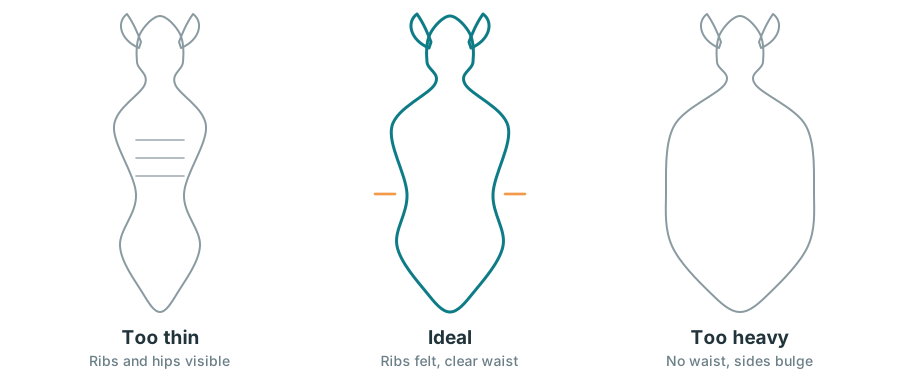
Do this on the first of every month and record the score. A single check is a snapshot; twelve checks are a trend, and a trend is what lets you correct a slow gain before it becomes two extra kilos and a lifetime of joint pain.
- Feel the ribs with flat hands, monthly, same day each month
- Look for a waist from above and a tuck from the side
- Weigh at the clinic on the same scales when you can
- Note the score in your phone or a notebook
- Ask the vet to score alongside you once, to calibrate your hands
Coat, skin and nails
Grooming is a health check you happen to be doing with a brush in your hand. Every session is a chance to feel for lumps, scabs, ticks, sore spots and thinning fur while the animal is relaxed and standing still.
Frequency by coat type
- Short, smooth coats: a weekly rubber curry brush is plenty.
- Double coats: brush two or three times weekly, daily while shedding. Never shave a double coat to keep it cool — the undercoat is insulation against heat as well as cold.
- Long or curly coats: daily line-brushing to the skin, or the mats form against the skin where you cannot see them.
- Cats: most self-groom, but long-haired cats and any cat over about ten need help, because stiff joints stop them reaching their back end.
Nails should not click on a hard floor or touch the ground when the animal stands square. Overlong nails change the angle of the toes and load the wrist and elbow wrongly. Trim a small amount often rather than a lot rarely, and keep styptic powder in the kit for the day you catch the quick.
Teeth and gums
By the time a pet reaches three, most have some degree of periodontal disease. It is painful, it seeds bacteria into the bloodstream, and it is almost invisible unless you lift the lip and look.
Daily brushing with a pet-specific enzymatic paste is the only home measure with strong evidence behind it. Human toothpaste is not safe to swallow — never use it. Build the habit gradually: a week of just touching the muzzle and giving a treat, a week of a finger with paste on it, then the brush.
- Lift the lip once a week and look at the gum line
- Brush daily, or at minimum every other day
- Choose chews and diets carrying a veterinary dental council seal
- Ask about a dental exam at every annual check
- Treat bad breath as a symptom, not a personality trait
Joints, mobility and pain
Animals do not limp until pain is significant. Long before that, they change what they choose to do — the cat who stops jumping onto the windowsill, the dog who takes the stairs one at a time, the rabbit who stops running the length of the room.
Cats in particular hide pain almost completely. Roughly nine in ten cats over twelve have arthritic changes on imaging, yet most owners report no limping at all. Watch for a cat who sleeps on the floor instead of high places, grooms less on the back half, or becomes short-tempered when handled.
Changes that help at home
- Non-slip runners on hard floors — traction matters more than padding.
- A ramp or a step to the sofa, the bed and the car.
- Litter trays with one low side, and food and water at a height that does not require crouching.
- Keep weight down; every extra kilo is loaded through the same joints.
- Keep muscle on with gentle, regular, predictable movement rather than weekend bursts.
Signs that mean call now
Most worries can wait for an appointment. This list cannot. If you see any of these, contact a vet or an emergency clinic immediately rather than waiting for morning.
Keep the number of your regular practice and your nearest out-of-hours clinic written somewhere that does not depend on a charged phone. In an emergency, call ahead so the team is ready when you arrive.
Common questions
How do I know if my pet is overweight?
Feel rather than weigh. With flat hands on the ribcage you should feel the ribs under a thin layer of fat, see a waist from above and a tucked belly from the side. If the ribs take pressure to find, your pet is carrying too much. Your vet can score them on the nine-point scale and set a safe rate of loss.
How often should I brush my dog's teeth?
Daily is the target, and every other day is a reasonable floor. Anything less has little effect on plaque, because plaque mineralises into tartar within a couple of days.
My cat isn't limping, so her joints are fine — right?
Not necessarily. Cats very rarely limp with arthritis. The reliable signs are changes in choice: less jumping, sleeping lower down, reduced grooming of the back half, and irritability when touched near the hips or spine.
Is a shaved coat cooler for a double-coated dog in summer?
No. The undercoat insulates against heat as well as cold and protects skin from sun. Shade, water, cool surfaces and walking at cooler hours do far more, and shaving can permanently change how the coat regrows.